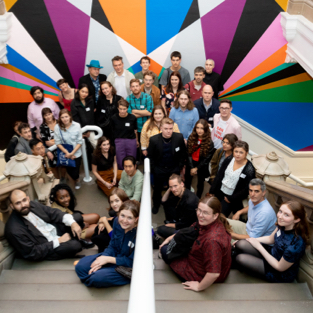
Millie Shafiee on her current practice, how taking part in New Contemporaries impacted her as an artist, and reflections on what makes a sustainable arts sector.
22 July 2025
“In three words I’d describe New Contemporaries as collaborative, exciting and new.”
I studied at the Royal Drawing School for my foundation year, and their approach to drawing is something that still influences my practice now. The Royal Drawing School’s rigorous approach to life drawing, drawing from observation and art history, gave me a strong foundation to start my Fine Art Degree at Newcastle University. Newcastle University’s Fine Art program gave me the freedom and support to develop my practice, the themes of which emerged early on in my degree. The sense of community during this program was incredibly special. The meals we shared with tutors and students at Green Finger Forum with the departments home grown produce and at the weekly Soup Wednesday’s, was a unique experience and a highlight of my final year. These communal meals encouraged poignant conversations between students, tutors and heads of departments, and it is something other art institutions might benefit from.
I primarily work in drawing, film, sound and installation. Light and space are key elements in my practice and my imagery is often created using drawings from film and drawings of observation from nature. My references to cinematic light highlight my experience of creating imagined stories from my family history. Being half Persian, my practice explores diaspora, inherited memory, and the fragility of oral histories, which become diluted or lost in translation. My ink drawings combine glimpses of family memories with the cinematic, narrative-based compositions in TV dramas, sci fi films and video games. My process of archiving audio recordings of family conversations in Farsi and English represent my struggle of grasping at and preserving ancestral stories.
Film has always been a strong influence in my practice, and a workshop I took part in on my foundation year, drawing from film, is something I always return to when I am seeking inspiration. The exercise involves drawing a series of rapid thumbnail sketches as a film is playing, and without pausing the film to try and draw the fleeting compositions from memory as they pass. The exercise is interesting as it really forces you to be selective, gestural and not precious about the drawings, which gives them a lot of movement and expression.
I graduated when Covid was still very recent so finding a job, especially a creative job, was very challenging at the time. The skills learnt on a Fine Art Degree can be transferred to so many creative careers, so it was also challenging trying to decide what career to focus on. I think something that isn’t taught at art school is how to make a career from your practice, and I hadn’t really considered this could be a possibility for me as a full-time career until I was selected for New Contemporaries.
“Meeting the more experienced artists and being part of the program has given me the confidence to pursue a career dedicated to my practice and not just something to work on on the side.”
I really enjoyed meeting the other artists and the New Contemporaries team at the openings and at the different programs they had in London, such as NC Live, the NC Film Program and A Vision With Artists workshop with Elle Reynolds. These programs were a fantastic opportunity to discuss the program with other artists and to learn about their practices and careers. It was talking one of the other artists, Valentino Vannini, at the ICA that lead to us being in another exhibition together this June. I am excited to take part in more events and exhibitions which might emerge from being part of this.
The mentorship programme was very helpful, especially at such an early and uncertain stage in career. My mentor Sim Panaser, Visual Art Curator at Chapter, was very knowledgeable and the in-depth conversations we shared about my practice really helped me to reflect on my career and provided me with great insight into programmes to apply to and advice for moving forward in my career. She gave me the confidence to pursue a career centred around my practice and her advice to see my practice as something to nurture, is something I will remember moving forwards.
I am excited to be selected for the Artists’ Make Space program at Orleans House Gallery, where I will be given a studio space until June next year and the opportunity to learn from their creative network in artist support sessions. I am also excited to start working in my first VFX role for a feature film and to continue my career in the art related aspects of film and TV production.
I think having open conversations between artists and institutions is extremely important. Institutions should learn directly from artists by listening to their feedback and how to improve the arts sector.
“I believe accessibility in the arts sector should be a priority for all institutions and programs, and direct feedback from artists is a valuable way to make these improvements.”
For example, some improvements could be: full transparency with accessibility budgets, and how they will be used, flexibility and pragmatism when supporting every individuals access needs.
Ask for help and advice from the people around you and from more experienced professionals, it can make a huge difference especially when applying for jobs and residencies.
Subscribe to the New Contemporaries newsletter for regular news, blogs and updates.